Featured

Catcher, Sleep, and miserable reality. Yay!

I am truly getting tired of typing My Year of Rest and Relaxation every week. Today we’re diving into how MYORR relates back to almost everything I’ve read in class this year, mainly Catcher In The Rye and the infamous Hamlet. If you couldn’t already take away the fact that the narrator is obviously depressed and practically empty, then either you’re being stupid or you haven’t read any of my previous blog posts, which you should probably do. Anyways the narrator is down in her dumps, she even goes as far as to say she can die at the very moment and be okay with it, which if you can’t make the connection, totally sounds like Hamlet the very depressed and very suicidal Denmark Prince and is way too similar to Holden Caulfield. The main connection between MYORR and these two novels from class is that of mental illness, suicidal thoughts, and dissociating. The narrator like the other two doesn’t mind death, and the narrator when connected to Holden a clear relation of dissociation can be presented. Holden dissociates through daydream like fantasies where he presents a hypermasculine trait of some sort that he desires but isn’t perceived to have from others viewpoint in reality, whereas our narrator dissociates by sleeping away her life.

Now Mr. Franklin might hate this, but I wasn’t a big fan of Hamlet and I’m not really feeling it in me to talk more about the connection between him and our narrator because aside from the fact that my heart isn’t in it, it’s also the fact that this specific connection is more obvious and very much more simple. It’s too easy to point out that they both want to die or they really can’t stand the people around them (sounds like a millenial), and both of their love lives are worse than mine.  What I really want to talk about and explore is the connection that can be made between Holden and the narrator from MYORR.

I find it really funny how many similarities I see not just between the two books but between the two characters even though the characters would probably hate each other if they met one another. I say that because Holden is this overidealistic kid that hates the adult world and how it strips everyone of their innocence, so he would be quite morridified by the narrator from MYORR, who is anything but innocent and in fact has normalised events and actions that Holden would find to be corrupt. The narrator would hate Holden because of how overidealistic and hypocritical he would be, she would probably critize him, calling him a stupid kid that doesn’t know a damn thing, and ultimately brush him off and probably try to avoid interaction with him, because this woman hates any human interaction there is in the world. 

Yet, even though these characters have two different agendas, live in different worlds and time periods, have different moral obligations and so on, they have both been destroyed and instead of confronting their feelings they chose to dissociate, only leading to more dissatisfaction. And even more so they do their dissociation in two very different methods and I think this connection in general is a great way to paint the picture of how mental health and illness has or hasn’t changed and how it has been shaped, and you could go even further to make the argument of how environment contributes to it, because a majority of both settings in both novels, is that of New York City. 

I just really enjoy the possibilities and the endless depth that this connection has to offer if one wanted to go on a more in depth literature analysis, especially with the contrast between the two. I like to think that a lot of MYORR is also a plot fueled by digressions just like Catcher, however the bigger more important difference, is the ending. MYORR is a novel about change and metamorphosis and it does more than just follow the narrator’s thoughts and depression, for me I like to see how the novel follows the narrator’s triumph and how she finds a way to fall in love with life again without having such love polluted by external and internal forces as before. Whereas with Catcher, we don’t know if Holden gets that happily ever after, everything is left up in smoke, and we have to make assumptions about whether or not he’ll truly be happy or fall back into another depressive episode that may just destroy him more than his unrealistic ideals.  

Another connection that can be further explored is that of cultural capital and social classes, both characters belong to a family with abundance and all their lives they haven’t really ever had to worry about money and such. They were born into a world of privilege and it seems that both characters are rather conscious of such a fact, what’s really interesting is how they react to it. The narrator from MYORR, tries to slink away from it, she doesn’t care about money or designer items, she could have almost anything, but chooses not to, whereas Holden doesn’t seem to mind having the money. At times it does seem to him that money and different classes do define much of social interactions and can go as far to determine someone’s friendships, such as the case with his previous roommate and Holden’s cowhide suitcases. 
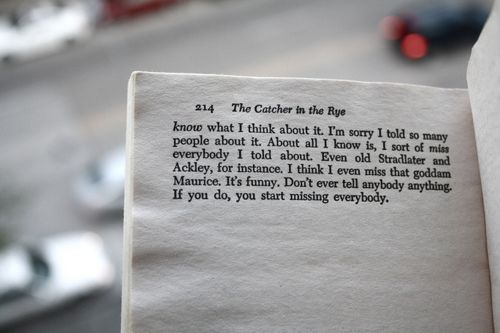
I ultimately find it unsettling how both characters are so much alike even though they are completely different and even the books in general. Two wildly different perspectives and time periods, I mean Catcher was written in the 40s and MYORR came out in 2015, yet both characters are destroyed by the realities they have created for themselves in their attempts to originally escape reality around them. So the question, I guess one can ask along these lines, is if the human mind has really ever changed or did the world change and human issues stayed the same? 

I haven’t really been getting much comments about what others think, more so just about style and writing, but I would genuinely love to hear what you believe to be the answer to the seemingly oversimplified and subjective question above that might just seem a bit stupid, but hey, I’m sure answering it is better than sleeping away your life or being obessesed over a way too red hat. Oh wait, nevermind, naps and hats sound much better than answering an existential question, and overall reading this blog.

“I don’t even like old cars. I mean, they don’t even interest me at all. I’d rather have a goddam horse. A horse is human at least.”

– J.D. Salinger
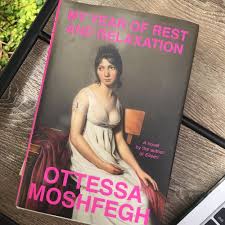
Review of My Year of Rest and Relaxation (No Spoilers)

My Year of Rest and Relaxation is one of the few books that I wouldn’t have ever read if I’ve seen it by itself on a bookshelf, not because it’s terrible, but because it’s so different from what I normally chose to read, however, despite that I truly did enjoy it very much. As frustrating as MYORR could be it really is a beautiful book. Taking place in the grandeur of New York City, it follows an unnamed narrator who tries to sleep away her life and fade away from reality, her only connection to the real world left, is her best friend Reva. The novel follows the narrator’s struggles and thoughts with the world around her and how she essentially self destructs and then learns how to piece herself back together and find a way to fall in love with life again. It’s one of those few marvelous books about a very realistic and beautiful story of misery, triumph, and change, and what makes it one of a kind is how much it leaves you questioning your own habits and thoughts afterwards, ultimately leaving you with a want to never waste another minute of your life. 

Ottesa Moshfegh’s writing style is one of the few styles that you can differentiate from other writers, she often takes to allusions and descriptions of gruesome and more morbid details to express what can’t be said right out, because of this she leaves a lot of what is to be said right in between the lines. In my opinion I personally love that, because it makes the reader dig more, and the novel as a whole much more memorable since it leaves the reader to fit the puzzle pieces together. However, what I don’t like about MYORR is the reading quality, at times it can be very anticlimactic and frustrating to read due to how disgustingly cruel the narrator could be, because of this I often found myself wanting to put it down and not continue reading. Luckily I did continue reading and that very much I don’t regret since the ending and how everything is chosen to be resolved was so beautiful and captivating. The other thing about the novel that I didn’t really appreciate was the characters, as realistic as they may have been which is a great aspect, I didn’t like how they were presented, because from the narrator’s point of view, everything seems terrible. So it was very clear how terrible these characters would be displayed, so I felt as though everyone was eventually going to hate certain characters from time to time due to what the readers are handed with, and I didn’t really appreciate that, because it’s more difficult to read a book when you hate every character including the narrator. 

Another way to describe MYORR, is convenient, the reason I say this is because unlike other novels, this one is versatile for things like in-depth analysis and close readings due to what and how much is left to be read in between the lines, so for students and class this is a perfect choice (even though it has some very sexually explicit scenes) because a lot can be done with it. Overall MYORR is a great novel and I’m very glad I read it, not only did I enjoy it but it left me with many new thoughts that I don’t think I would’ve made on my own unless I had seen Moshfegh and the narrator’s perspective. I would like to clarify though, that this book almost has its own niche for a certain type of reader and I don’t believe that some people who do actually enjoy to read would like it or even finish reading it, just because it is very different from what most people do choose to read and at times it just isn’t a exciting novel and only moment where it does become great is the ending. However, if you can push through a novel when it gets anticlimactic, morbid, and infuriating, or just love literature and a feel good story, then you should read MYORR because of how triumphant the ending is, I would even go as far to say, that this is by far the most triumphant and greatest endings in literature and in much of anything that I’ve read up to this point, because it was just that beautiful and Moshfegh’s style is truly a one of a kind amongst modern American literature.

“I had no big plan to become a curator, no great scheme to my way up the ladder. I was just trying to past the time. I thought if I did normal things – held down a job, for example – I could starve off the part of me that hated everything.”

Ottesa Moshfegh, My Year of Rest and Relaxation

The Death Of Marat In My Year of Rest and Relaxation

In my first blog post I failed to mention some very important things such as how our narrator had worked at an art gallery and is a Columbia Graduate who majored in Art History and ultimately her constant critique of every artwork that has come across her path. She trash talks these artworks and the artist behind them, it’s almost as though she finds anything perceived to be art as unconventional, more precisely the more modern artworks in today’s society that would be deemed abstract and equally as brilliant. She hates loud, vibrant colors that practically explode off the canvases and the stories behind them, more specifically she hates the reasons and inspirations behind the paintings and the messages the artist is trying to convey. She calls it all a load of bull and seems bored out of her mind, yet for someone who seemingly hates almost every artwork she is surrounded by, she has a favorite painting.

“I was permitted to take my seat. Out the window of the classroom, flat, wide yellow leaves fell from a single tree onto gray concrete. I dropped the class, had to explain to my advisor that I wanted to focus more on Neoclassicism, and switched to “Jacques-Louis David: Art, Virtue, and revolution.” The Death of Marat was one of my favorite paintings. A man stabbed to death in his bathtub.” (Moshfegh 190)

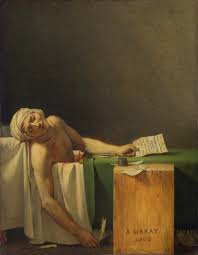
Death of Marat

The Death of Marat, which I immediately recognized due to AP Euro (thanks JT) is painted by Jacques-Louis David depicting the newly murdered French revolutionary leader Jean-Paul Marat. The painting is essentially a man lying in the bathtub dead, with a stab wound in his chest and gripping a document he was writing. You see Marat had this really weird skin condition that made him spend too much time in the bathtub, so he would often place this wooden board across his tub and sit there for hours just writing and working, because if you’re stuck in a tub for a while you might as well make the best of it, right?  Then one day, Charlotte Corday came along. Corday belonged to a minor aristocractic family who were estentially nobility and if you don’t know the French Revolution, just know it wasn’t too friendly to the Nobility or monarchy, because of this Corday and her family felt threantedned by this revolution and the potential it had, so naturally instead of fleeing the country she decides to murder one of its leaders, as if that won’t set off a terrible chain of events in retaliation. Corday comes into Marat’s room promising information on another revolution that was taking place at the same time in Caen and when she comes in, sees him in the tub, she takes advantage of the opportunity and stabs him to death. 

To this day The Death of Marat is considered the first Modernist Painting in the world and is revered by many artists and critics alike and holds much significance to the French Revolution, for afterwards this painting and Marat’s death were used to essentially rally anybody who wanted to overthrow the nobility and monarchy during the revolution, this event and this portrayal of it immortalized Marat and the essence of what it meant to be a revolutionary man. It made him seem as a martyr, that in his last moments he was working towards what many deem a better France and a more democractic government. Oh and if you’re wondering, no, Corday did not save her family or the wealth she aimed to keep from the revolutionaries, and I thought I was a failure. 

Anyways Marat is an important figure to the revolution, to France, and the world in general, but he was also rather successful in his endeavors. He’s practically the opposite of our narrator and the mention of this painting reminds me of Hamlet and the scene in which Hamlet holds Yorick’s skull and realizes that death spares no one, it’ll come for the rich and poor alike and rip the joy and life out from one in a heartbeat (this is really depressing but truth has no moral yall.) However, unlike Hamlet our protagonist doesn’t necessarily realize the importance of life or have an epiphany at the thought at such a sudden and gruesome death. Moshfegh could’ve thrown out any famous painting, she could’ve even made one up right then and there, but she didn’t, she chose to make this allusion and further link the motif of death and art to the narrator, as though the two, just like the painting, are physically linked to one another in life and more specifically to the narrator’s life. 

Perhaps the use of such allusion was used to bring in the afterthought of what our narrator desires the most: rebirth and falling in love with life again. You see Marat in this painting is depicted as someone pure, someone accomplished, and above all someone loved. Within the painting he is depicted with a soft, light, glow on his skin immediately drawing the eye to him, that even in death he still attracts the attention of others, but not because he wanted it, but instead because he was fighting for something and people appreciate that, and that is what the narrator craves: love, respect, and attention. Throughout this novel and the continuation of the Moshfegh’s style, readers are always slapped in the face by the emptiness, precision, and occasional bitterness. Our narrator is so clearly depressed and exhausted by life, for existence has become nothing for her and she, whether or not choses to admit it, is defeated by that. She wants to live, she wants to fall in love with life again, and be happy because she is so tired of such a dreary and muted existence that belongs to her unlike that of Marat. 

Perhaps the Death of Marat was brought up for other reasons, or maybe I hit the nail on the head (I like to think I did because my ego refuses to let me think otherwise), or maybe I am overthinking and over interpreting as Saleehia would think I am, but for me I believe it’s the author’s way of saying that just like the narrator, us readers aren’t ever as great or will be as Marat was perceived as. Because unlike him we all continue on rather mute existences and further on don’t really change our lives or the world, it’s almost as though the Moshfegh is calling out the ordinary man through the narrator’s likes and dislikes in a way to challenge the lives we slave away at simply because they are what she would deem as terrible as death itself. Or maybe she just put it in there because the French revolution was wild. Guillotines and fires everywhere and rich mean people dying, we should really bring that back.

“Because in the end, you won’t remember the time you spent working in the office or mowing your lawn. Climb that goddamn mountain.”

– Jack Kerouac

Design a site like this with WordPress.com
Get started